August 14, 2026
32% is the share of midsize premium SUV owners who bought a non-luxury brand when they traded in the first half of 2026, according to JD Power’s OEM intelligence data. Mainstream midsize SUVs took 11% of those transactions and compact SUVs took 6%. Compact premium SUV owners defected at 30%, and compact premium car owners at 42%. Midsize premium SUVs are the largest premium segment by volume, which makes the largest defection rate the one attached to the most units.
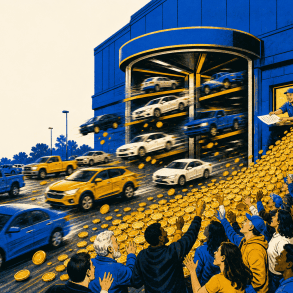
13.3% of new vehicle sales went to premium brands in the first half, excluding direct-to-consumer marques, down from 13.8% a year earlier and the lowest premium share since 2020. Half a point of share sounds modest until it is priced. On a market running near a 16 million unit annual pace, half a point is roughly 80,000 units a year moving out of stores whose fixed cost structure was built for premium gross.
$19,100 Is the Size of the Decision
$70,600 was the average transaction price of the premium segment being traded, against $51,500 for the mainstream midsize SUV being purchased. The gap of roughly $19,100 is not a rounding difference in a monthly payment, it is a different financing bracket. JD Power’s demographic cut shows exactly where that math bites: households above $200,000 in income stay premium, retention weakens as income falls, and defection is highest among Gen Z buyers and rises steadily as you move down from Boomers.
27% of the defectors live in rural areas against 19% of premium buyers who stayed, and 51% are suburban. Premium buyers who stayed are concentrated in cities at 34% against 22% for the mainstream switchers. Geography is a proxy for what a badge buys. In a dense market where the car is seen by more people more often, the badge still does work. In a driveway on an acre, it does less of it.
The Feature Gap Closed Before the Price Gap Did
29 points now separate premium and mass market brands on JD Power’s APEAL emotional satisfaction scale, down from 66 points in 2008. The study finds premium no longer holds a consistent advantage in infotainment, exterior execution, driver assistance, headlight performance, or the sound of a closing door. That last item is not a joke in this business. Door close sound was a demonstrable luxury cue for thirty years and it was expensive to engineer.
Electric vehicle competition is what JD Power credits with the convergence, and the mechanism is worth stating precisely because it cuts against the usual reading of the EV slowdown. Competing on electric drivetrains pushed every manufacturer to invest in displays, software, connectivity and driver assistance. Those investments landed in combustion and hybrid vehicles too. GCBC’s coverage of the 2026 APEAL results found satisfaction rising while US electric vehicle sales fell, and this is the same finding viewed from the premium side. The technology arms race produced better mainstream cars whether or not it produced electric ones people bought.
Initial quality is where premium is losing ground it used to own outright. JD Power points at infotainment problems, difficult vehicle setup and poorly executed technology as limits on premium satisfaction. A brand charging a $19,100 premium for an experience that frustrates the owner during the first month of ownership has an argument problem no incentive fixes.
Inventory and Incentives Are Already Carrying the Weight
7.3% of MSRP is where premium incentive spending sat last month, against roughly 6% for mainstream. Premium began this cycle at about 5.9% in June 2025 and has run above 7% for most of 2026. Days supply tells the same story: premium peaked near 76 days in April and had eased to about 67 by last month, still well above the roughly 56 days mainstream brands carry. Premium brands are discounting into softer demand and holding more stock while they do it.
Discounting a luxury brand to hold share is a defensible short-run decision and a corrosive medium-run one, because the discount trains the buyer to value the badge at the discounted price. Residuals follow transaction prices, lease payments follow residuals, and the payment advantage that brings a customer back in 36 months erodes from both ends. Stores selling Lexus, BMW, Cadillac and Audi are running that experiment in real time this year.
$125,900 before destination is where Lucid opened orders on the Gravity GT-S on August 13, a 1,070 horsepower three-row debuting at Pebble Beach and aimed at the top of a pool that is thinning from the bottom. Halo products still work at the very top of the income distribution, which is precisely the cohort JD Power finds is not defecting. The exposure sits in the accessible premium models that were built to widen the funnel, because those are the vehicles a $51,500 mainstream crossover now competes with on features a buyer can actually see.