Owner Review:
I spent my entire driving life avoiding full-size pickups. The reasons were practical, not emotional. Fuel economy that made you wince at every gas station, and a footprint that turned parking garages into stress tests. The third-generation Tundra solved both problems, and I bought one.
Mine is a 2024 Tundra Platinum in black, CrewMax cab with the 5.5-foot bed, i-FORCE MAX hybrid powertrain, and the TRD Off-Road package. Sticker north of $70,000. That is a lot of money for a pickup truck, and I want to be upfront about that before explaining why it earns it.
The Hybrid Changes Everything
The i-FORCE MAX pairs Toyota’s twin-turbo 3.4-liter V6 with an electric motor sandwiched between the engine and 10-speed automatic. Combined output is 437 horsepower and 583 lb-ft of torque. Those numbers are not theoretical. This truck pulls with authority that makes the old 5.7-liter V8 feel leisurely by comparison.
Here is the number that matters most for daily driving: I am averaging roughly the same fuel economy as our BMW X3 M40i. Read that again. A full-size pickup truck with nearly 11,000 pounds of towing capacity returns comparable mileage to a performance luxury crossover. The hybrid powertrain does not just save fuel. It fundamentally removes the biggest rational objection to owning a full-size truck as a daily driver.
My wife asked early on why Lexus does not make a pickup. After spending time in the Platinum trim, she stopped asking. The interior quality genuinely approaches Lexus standards, which should not surprise anyone familiar with the platform sharing between the Tundra and the Lexus LX. The seats, the materials, the JBL audio system, the panoramic moonroof, the ambient lighting. This is a luxury vehicle that happens to have a bed.
 Technology That Earns Its Price
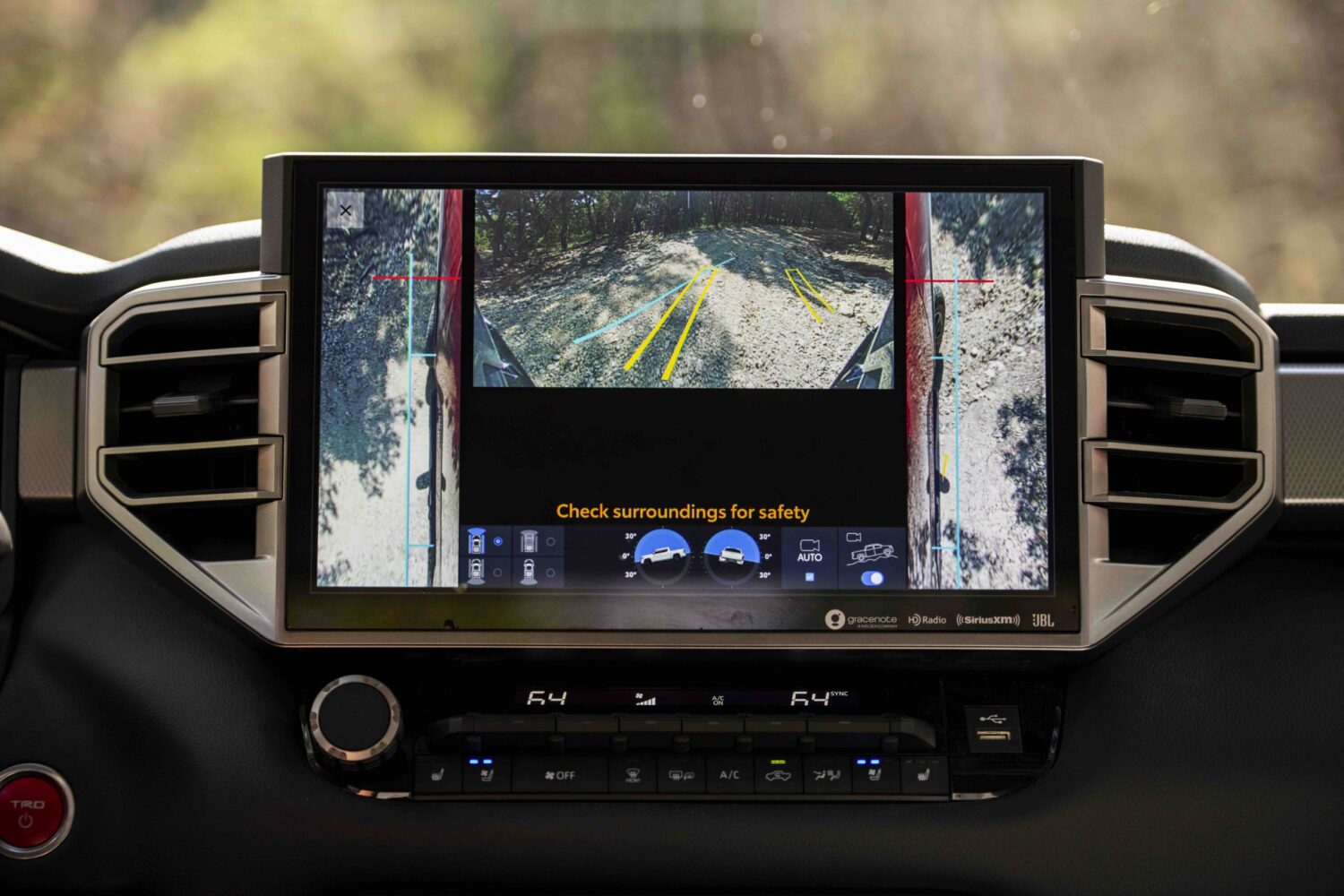
The 360-degree camera system deserves its own paragraph. Crystal clear, HD resolution from every practical angle. This single feature eliminated my other lifelong objection to full-size trucks. Parking, reversing, navigating tight spaces, pulling into the garage. The suite of sensors and cameras provides visibility that most sedans cannot match. Combined with front and rear parking sensors, blind spot monitoring that extends for trailers, and Toyota Safety Sense 2.5, this truck is genuinely easier to place precisely than vehicles half its size.
The 14-inch touchscreen runs Toyota’s latest multimedia system competently. The 12.3-inch digital gauge cluster puts vehicle information, off-road telemetry, and towing data right in your sightline. Heated and ventilated front and rear seats handle Colorado mornings and Arizona afternoons equally well.
Tested, Not Theoretical
We have taken this truck to Sedona, across New Mexico, through Moab, and into the Colorado Rockies. The TRD Off-Road package adds Crawl Control, Multi-Terrain Select, a locking rear differential, and the Panoramic View Monitor configured for trail use. On slickrock, sand washes, and mountain passes, the Tundra never felt uncertain.
The hybrid powertrain offers a specific advantage off-road that specs do not capture. At low speeds, the electric motor provides instant, smooth torque delivery that makes technical terrain more manageable than a conventional engine’s power curve. Crawl Control operating through the hybrid system is remarkably composed.
But the best use case is camping. CrewMax cab, 5.5-foot bed, nearly 11,000 lbs of towing capacity. Room for the family, the dog, all the glamping gear, and whatever else you want to bring. The composite bed shrugs off coolers and equipment. The rear window rolls down completely for airflow. It is, without reservation, the best vehicle I have ever owned for extended outdoor trips.
The Shopping Process
We cross-shopped the Ford F-150 Tremor and GMC Sierra AT4X before buying. Both are capable trucks with their own strengths. The Tundra won on three points.
First, the hybrid powertrain. Neither competitor offered an equivalent combination of power, fuel economy, and refinement at the time. The Tundra’s hybrid makes futuristic sounds under acceleration, pulls like a freight train at any speed, and in my experience handles meaningfully better than both the Tremor and AT4X.
Second, the technology suite. Toyota’s sensor and camera package felt a generation ahead of what Ford and GM offered in those trims.
Third, long-term confidence. Toyota’s reputation for durability carried weight in this price range. The third-generation Tundra has faced well-publicized recall issues with the gas-only V35A engine, involving machining debris that can damage crankshaft bearings. Toyota’s response has been responsible: full engine replacements at no cost, phased recall implementation, and proactive expansion of the recall to additional model years. The i-FORCE MAX hybrid powertrain is not affected by these recalls. We have had zero issues.
The Verdict
The 2024 Tundra Platinum i-FORCE MAX is expensive. There is no getting around a $70,000-plus transaction price. But for buyers who want a full-size truck that doubles as a legitimate luxury daily driver, this configuration makes a compelling argument. Toyota solved the fuel economy problem with the hybrid. They solved the maneuverability problem with the camera and sensor suite. And they wrapped it all in a cabin that makes the “why not just buy a Lexus” question genuinely difficult to answer.
Tundra sales grew over 27% in 2024, driven largely by hybrid model demand. I understand why.