August 21, 2026
$3.1 billion is the recognized digital-services revenue General Motors has guided to for 2026, against roughly 13 million OnStar subscribers by year-end, reported by Automotive News on August 20. OnStar generated about $800 million in the second quarter alone, up more than 20% year over year. Google Gemini has gone out to roughly 4 million model-year 2022 and newer Chevrolet, Buick, GMC and Cadillac vehicles, and GM has said it intends to launch its own native assistant this year. Ford is extending its assistant to 8 million more eligible vehicles including Lincoln.
Every one of those vehicles was sold by a franchised dealer, and most of them are serviced by one. That is the part of this week’s disclosure worth sitting with. GM did not announce a product. It announced that the installed base has a recurring revenue number attached to it, and put the number in a guidance range, which converts a roadmap item into something a competitor has to respond to.
The Dealer Was Already Monetizing the Same Vehicle
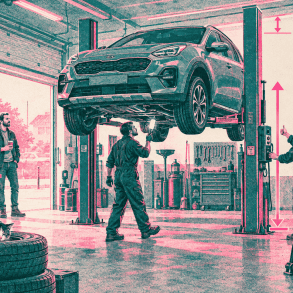
$5 million is the average dealership’s parts and service gross profit in 2025, up from $3.3 million in 2020, according to CBT News reporting on the fixed operations trend. That is a 52% increase over five years in the line item that pays a store’s fixed overhead. It is also, in the same period, the line item that grew while new vehicle gross compressed.
GCBC published the first half of this argument in April, when record service revenue was arriving alongside a shrinking share of the repair market. The second half arrived this week from the other end of the value chain. Fixed operations is no longer the hedge a store runs while it waits for the new vehicle market to recover. It is the business, and the manufacturer has now published a plan to earn recurring revenue from the same vehicles without touching a service bay.
Those two revenue streams are not additive from the customer’s side. A household with a $768 average monthly payment has a finite tolerance for further monthly charges against the same vehicle, and the subscription and the service plan compete for it. Neither GM nor Ford has committed to a permanent no-subscription model, which means the question of who owns that relationship stays open.
Dealers Are Paying for AI at a 22% Hit Rate
82% of dealers now use AI, and 22% of those who expected it to drive sales and revenue growth say they have seen those outcomes, per Cox Automotive’s new AI in Auto Retail Tracker. Sixty-nine percent expected the revenue. The top three uses are automating routine and complex tasks at 40%, coordinating customer follow-up at 40%, and generating content at 38%. Roughly one dealer in three either is not measuring the impact or cannot say how.
63% of shoppers say they plan to use AI to shop for their next vehicle while 29% of dealers have started adjusting to AI-powered search. That gap is the operationally useful number in the study, and it is a different problem from the revenue gap. GCBC found the same asymmetry in pricing transparency, where disclosure moved from compliance chore to search-rank asset. The store that does not restructure its inventory data for a machine reader loses the shopper before any conversation starts.
Set the two datasets side by side. The manufacturer books software revenue off vehicles it no longer owns, with a subscriber count and a guided dollar figure. The dealer spends on software to defend a customer relationship, with one in three unable to measure whether it worked. Both are chasing the installed base. Only one of them is currently able to prove a return.
The Aftermarket Is the Control Group
$2.0 billion in second-quarter net sales, essentially flat, with comparable sales down 0.5%, is what Advance Auto Parts reported on August 20. Adjusted earnings per share came in at $1.03 against a consensus near $0.81, and full-year adjusted guidance rose to a range of $2.60 to $3.30 from $2.40 to $3.10. Roughly $26 million in tariff refunds contributed about $0.31 of that per-share result, which makes a large part of the beat non-repeating. The professional channel grew in the low single digits while do-it-yourself demand dropped sharply in the final four weeks of the quarter, per the company’s results release. The market priced the flat revenue and the do-it-yourself drop rather than the earnings beat, and the stock fell on the day the guidance went up.
The channel split is the finding. Repair work is migrating from driveways to service bays, which is bullish for the fixed operations line at a franchised store and bearish for the parts retailer selling to the owner directly. That migration has an obvious driver: the vehicles being repaired are older and more complex, and the US market is keeping them longer.
Three businesses now bill the same parked vehicle. The manufacturer sells it software on a subscription. The dealer sells it labor and parts through a bay. The aftermarket retailer sells the owner a component to fit themselves, and that third one is losing share to the second. GM’s contribution this week was to publish what its slice is worth. $3.1 billion is modest against total company revenue and very large against the $5 million a franchised store grosses in a year from parts and service, which is the comparison that matters to anyone selling Chevrolet or GMC out of a single rooftop. It is also growing from a base the dealer cannot see into.