November 16, 2026
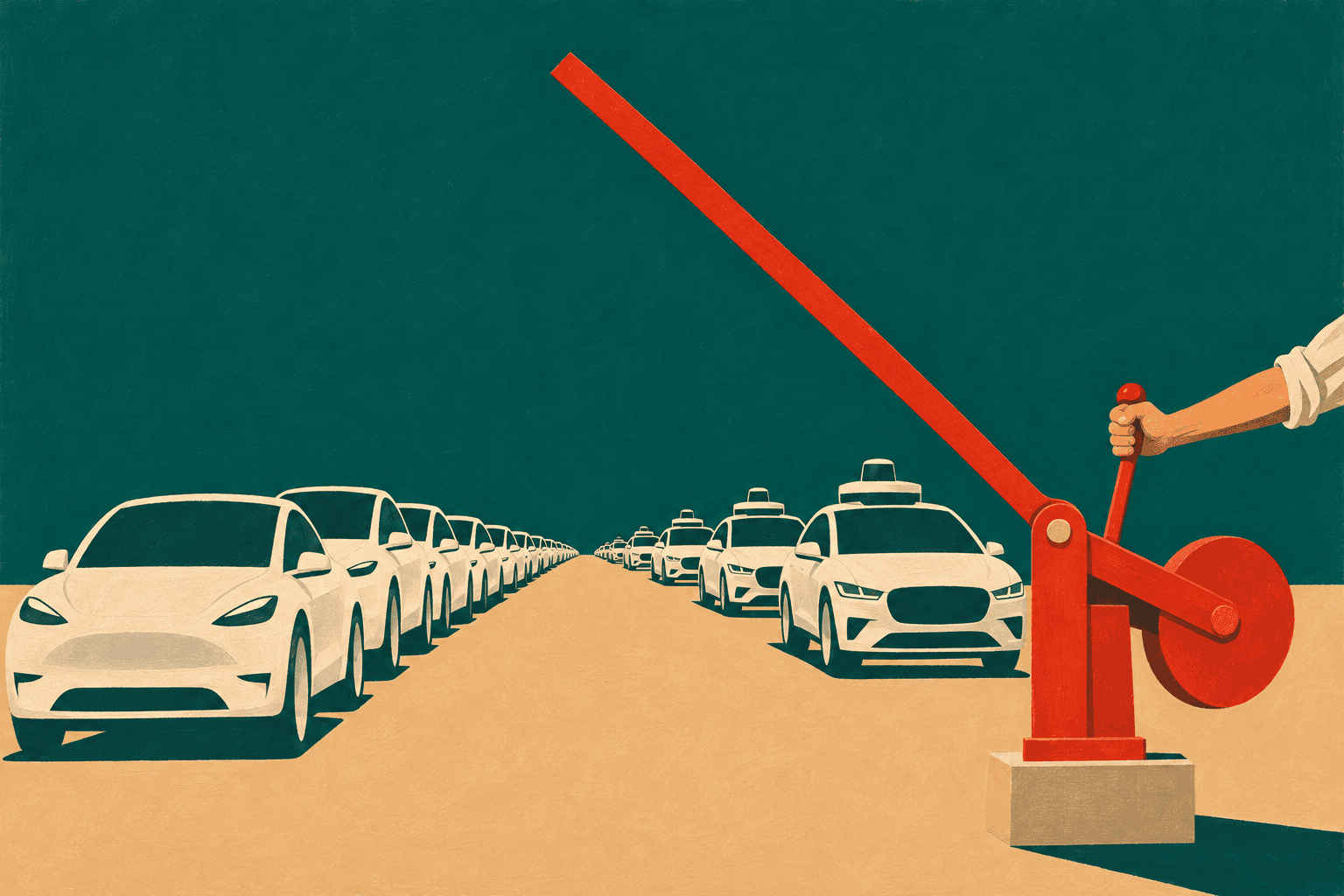
On the Texas state list, Tesla now has almost as many vehicles cleared to run without a driver as Waymo. The Texas Department of Motor Vehicles’ vehicle summary report, with data as of November 16, puts 1,306 automated vehicles under Tesla Robotaxi LLC’s authorization and 1,321 under Waymo’s. The same report on October 29 had Tesla at 1,080, behind Waymo’s 1,259.
In 18 days Tesla’s count rose by 226 and Waymo’s by 62. Tesla’s grew by about a fifth, Waymo’s by about a twentieth. On the one count both companies have to file, the robotaxi race in Texas is close to a tie, and Tesla is the one moving. But a vehicle on this list is a permission, not a ride, and the state that keeps the list can also take it away.
Waymo’s late-October push was in territory, and outside Texas: on October 27 it said it was adding nearly 250 square miles across Los Angeles, Nashville, Orlando, San Diego and the San Francisco Bay Area.
The count both companies have to file
Since May 28, any company running automated vehicles commercially in Texas without a human driver has needed an authorization from the department, under Senate Bill 2807, a 2025 law. The program’s rules ask each company to list its vehicles, certify that the Department of Public Safety holds its plan for how police, firefighters and paramedics should deal with them, and report material changes within 30 days. There is no fee, and an authorization does not expire.
Texas’s list has more than doubled since June. Department staff told the agency’s automated vehicle advisory committee on June 29 that 16 companies held authorizations covering 1,457 vehicles, according to the meeting transcript. The November report counts 17 companies and 3,451 vehicles. Tesla and Waymo hold about three in four of them. Next comes Avride, with 344, while Amazon’s Zoox lists 63. Getting on the list takes paperwork the companies certify themselves: staff described the application as fully web based, with “no requirement to submit any documents,” and a written statement from the company that its vehicles meet the law’s criteria.
What 1,306 does not say
The November 16 report gives a company name and a vehicle count, and nothing else. It names no city and no model, and it counts no rides and no cars running without a person aboard. How many of Tesla’s vehicles are in service on a given day is not in it.
When GCBC last set the two side by side in May, Waymo had just paused service in its Texas cities after one of its cars drove into a flooded street in Atlanta, and plate-spotters counted 44 Teslas running unsupervised in Austin. A plate count and a permission list measure different things, but the distance between them is the question the state’s count leaves open.
The state’s one lever
Under the Texas program, the department can suspend, revoke or restrict an authorization when a company’s operation “has resulted, or is likely to result, in serious bodily injury,” its program page says. The company first gets time to correct the problem, then can ask for a review and a hearing before the State Office of Administrative Hearings. California has taken another route, with a new law that puts a clock on robotaxis that block fire crews. In Texas the lever is the authorization itself, and a fleet growing at Tesla’s pace gives the department more cars to watch.
Whether Tesla has passed Waymo on the Texas list will show in the next report. The department has published two, 18 days apart, and states no schedule. What would change the race more than either total is the first time the department suspends an authorization.