October 5, 2026
On September 30, California’s governor signed SB 1246, one of 177 bills on the day’s legislative update. The bill’s author describes the law in five parts: local penalties when a driverless vehicle obstructs emergency response operations for more than 30 minutes, remote drivers based in the United States with a US driver’s license, notice to local jurisdictions of where vehicles are during a system-wide failure, an on-site contact for first responders, a “local incident technician”, at crashes and obstructions, and expanded incident reporting. All of it takes effect July 1, 2028.
The 2026 rules reach the phone line
The DMV’s April 28 regulations, which GCBC covered when they began taking effect in July, already require an operator to answer a first responder’s call within 30 seconds and to move its fleet out of an area emergency officials close within two minutes. Police can also send a Notice of AV Noncompliance to the manufacturer when a driverless car commits a moving violation. Each of those duties runs through the company’s operations center. SB 1246 adds a duty that runs through the street: a person who arrives where the car has stopped.
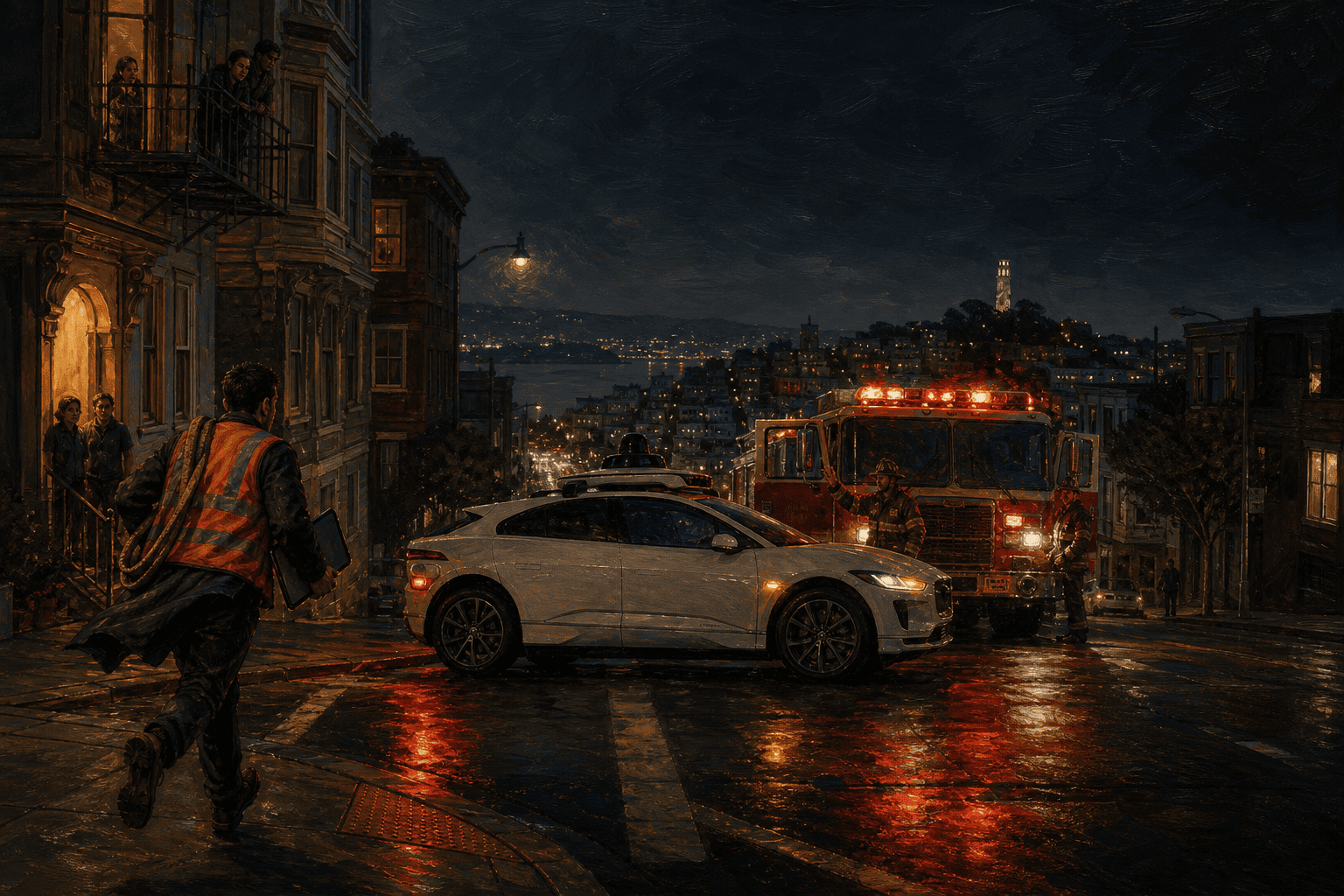
About 1,500 Waymo vehicles stalled during a San Francisco power outage last December, according to the author’s office, and first responders trying to reach the AV companies were left on hold for up to 53 minutes. The office also cites July 4 this year, days after the DMV rules began taking effect, when multiple Waymo vehicles blocked roadways and ran out of power during the city’s celebrations. A call answered in 30 seconds reaches a dispatcher; it does not move a car that cannot drive.
In July, GCBC argued that California had built the enforcement mechanism Washington lacked, after NHTSA’s July 8 letter called a robotaxi that cannot deal with first responders a danger to the public and set a deadline only for meetings. The Fourth of July stalls test half of that claim. The state’s citation tool is written for moving violations and its 30-second rule reaches the company’s phone, and neither put anyone at the corner. SB 1246 is the legislature’s answer to that gap: a penalty measured in minutes and a technician on site.
Nearly 21 months with the phone rule
July 1, 2028 is nearly 21 months away, and the federal picture has not filled the time. NHTSA’s September report to Congress on automated-driving research and rulemaking describes a co-regulator event with panels of police, fire and EMS officials, and proposed equipment rules, and it lists no adopted standard for how a driverless car behaves at an emergency scene. Until 2028, the DMV’s 30-second and two-minute rules are what binds every driverless fleet on California streets when an engine company needs the road.
More than 40 organizations registered opposition when the Assembly’s communications committee analyzed the bill in June, Tesla, Honda, Volvo, Waymo, Cruise and Nuro among them on the committee’s list. The measure still passed the Assembly 65 to 11 on August 30, and the Senate concurred 28 to 7 the next day, according to LegiScan’s record of the votes.
What gets decided before 2028
The DMV decides next. Under the bill as the Assembly analyzed it in June, the department sets reasonable response times for incident technicians, and that number decides whether the on-scene duty costs an operator a technician per neighborhood or per county. Operators already carrying passengers in California, Waymo’s Jaguar I-Pace fleet among them, have until July 2028 to staff for it. A surprise would be the DMV writing technician response times into its own regulations before the statute’s date, or an operator announcing a California technician network ahead of the deadline; either would mean the phone rule stops being the whole standard sooner than the law requires.