March 27, 2026
Sixteen months after killing Cruise, General Motors put self-driving cars back on public roads. The company announced March 23 that 200 test vehicles are now operating on highways in Michigan and California, running SAE Level 3 autonomous technology that lets drivers take their eyes off the road entirely.
The difference from Cruise is the business model. Cruise was a robotaxi fleet. These are consumer vehicles. GM is not trying to replace Uber. It is trying to sell you a Cadillac that drives itself on the highway.
The Post-Cruise Playbook
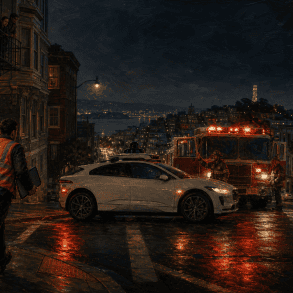
GM exited the robotaxi business in late 2024 after Cruise accumulated billions in losses and a high-profile pedestrian dragging incident in San Francisco that triggered a regulatory crisis. The pivot was decisive. Shut down the fleet. Keep the engineers. Redirect the technology toward vehicles people actually buy.
The L3 system builds on Super Cruise, GM’s existing highway hands-free driving technology. Super Cruise is Level 2, which means the driver must watch the road even when the car is steering itself. Level 3 removes that requirement on approved roads. The driver can look away, read, or check a phone. The car is responsible.
That distinction matters legally and commercially. At Level 2, the driver is liable in a crash. At Level 3, the automaker accepts responsibility when the system is engaged. GM is betting that consumers will pay a premium for that transfer of liability, starting with the Escalade IQ in 2028.
Four Companies, Four Strategies
GM’s L3 consumer play crystallizes a fragmentation in the autonomous vehicle market that has been building for years. Four major players are now pursuing four fundamentally different approaches.
GM is building L3 technology for privately owned consumer vehicles, starting at the top of its lineup and targeting highway driving. Waymo operates fleet robotaxis in dense urban environments, with no plans to sell vehicles to consumers. Hyundai and Kia deepened their NVIDIA partnership this month for a platform approach spanning L2+ in production vehicles through L4 robotaxis via Motional. Tesla continues to push Full Self-Driving as a vertically integrated software product while facing an NHTSA Engineering Analysis covering 3.2 million vehicles.
Each approach carries different risks. GM’s risk is that L3 certification takes longer than expected. The regulatory framework for L3 consumer vehicles does not fully exist in most U.S. states. Waymo’s risk is unit economics. Hyundai-Kia’s risk is platform dependency on NVIDIA. Tesla’s risk is regulatory, with the FSD probe now one step from a mandatory recall.
Why the Escalade IQ Goes First
GM chose the Escalade IQ as the launch vehicle for a reason beyond prestige. The Escalade IQ starts above $100,000, giving GM room to absorb the sensor, compute, and software costs of an L3 system without destroying margins. Luxury buyers are also more tolerant of early-adopter limitations like geofenced highway-only operation.
The strategy mirrors how Mercedes-Benz introduced its Drive Pilot L3 system in Germany, starting with the S-Class and EQS. Mercedes remains the only automaker with a certified L3 system in production anywhere in the world, though its approved speed of 60 km/h (37 mph) limits practical utility to traffic jams.
GM’s highway-speed testing suggests a more ambitious certification target. Highway driving at speed is technically simpler than urban navigation, which is why GM chose it. Fewer pedestrians. Fewer intersections. More predictable geometry. But highway-speed L3 means the car is responsible at 70 mph, not 37. The liability math changes significantly.
The Timeline Question
A 2028 consumer launch gives GM roughly two years of public road testing data, regulatory engagement, and software refinement. That timeline is aggressive for a technology that requires both technical validation and regulatory approval.
The 200-vehicle test fleet in two states is a meaningful start. Super Cruise already operates on over 400,000 miles of mapped highway, giving GM a head start on the mapping and infrastructure side. The question is whether two years is enough to satisfy regulators that the system is safe for unsupervised highway driving at full speed.
GM has not disclosed what sensors the L3 system uses beyond Super Cruise’s existing LiDAR, cameras, and radar. The company has not specified which highways are included in the test. It has not named a target certification state.
What it has done is put 200 cars on the road, announced a product and a date, and staked its autonomous driving strategy on a model its customers can actually buy. After the Cruise debacle, that clarity is the point.