May 1, 2026
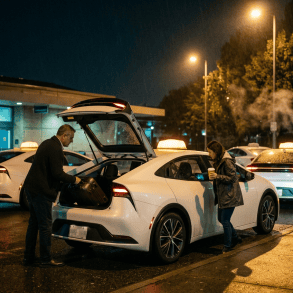
On April 28, XPeng opened consumer pre-sales on the GX flagship at 399,800 yuan, approximately $58,000 at the current exchange rate. The launch closed out the company’s Auto China 2026 announcement cycle that opened with the April 24 keynote. The GX is positioned by XPeng as China’s first factory-integrated L4 robotaxi prototype rather than as a conventional consumer launch.
The price-versus-spec line that matters for US industry readers fits in one sentence. Six-seat AWD layout. 750 km of pure-electric range on the CLTC cycle, which translates to roughly 466 miles. Four in-house XPeng Turing chips combining for 3,000 TOPS of compute. Bosch steer-by-wire. Aviation-grade redundancy on the safety-critical systems. The base price is 399,800 yuan, roughly $58,000 USD.
The closest US-available luxury BEV comparison is the BMW iX3 at approximately $60,000 with around 400 miles of EPA-rated range. The iX3 took 2026 World Car of the Year. It is the current benchmark for premium-electric in the $60K bracket. The XPeng GX matches that price point with more range, more compute, and L4 prototype hardware that BMW does not offer at any price.
What’s Actually in the Compute Stack
The four Turing chips at 3,000 TOPS combined is the most aggressive in-house silicon stack any consumer-priced BEV has shipped to date. Tesla Hardware 4 runs roughly 144 TOPS. Nvidia Drive Thor at the consumer-vehicle level targets 1,000 TOPS. The XPeng GX runs 3,000 TOPS as standard equipment at the $58,000 entry price. That compute headroom is what enables the L4 prototype designation. The car is not L4 in regulatory practice. It carries the hardware to support an L4 software upgrade if XPeng or a partner deploys one through the vehicle’s life.
The VLA 2.0 software stack is what runs on top of the silicon. The Vision-Language-Action 2.0 model is XPeng’s third-generation in-house ADAS architecture, replacing the Vision-Language-Model approach that shipped on the prior P7 and G9 generations. VLA 2.0 is what the marketing language at the April 24 keynote called the “physical AI” framework. The technical translation is that the model fuses camera, radar, and LiDAR perception into a single end-to-end neural net rather than the traditional perception-prediction-planning pipeline.
The Dual Identity
XPeng is simultaneously a consumer-vehicle competitor to BMW and Mercedes and a Tier-1 software supplier to Volkswagen Group. That is the structural angle worth holding. The ID. UNYX 09 production at SAIC-VW Anting is running on XPeng’s VLA 2.0 stack under a development partnership announced earlier in the cycle. VW’s first-ever brand EREV (the ID. ERA 9X at $47,720) ships on XPeng-developed software running through Tencent, Alibaba, and Baidu LLM partnerships.
The dual position is rare in the auto industry. Mobileye is a software supplier without a vehicle of its own. Tesla is a vehicle company without a third-party silicon arm. XPeng is the only major OEM running both businesses concurrently at scale. The April 24 to 28 launch sequence demonstrated both at once. The GX is the consumer product. The VW partnership is the platform-vendor business. The April 24 keynote announced the IRON humanoid robot mass production for Q4 2026 and Land Aircraft Carrier modular eVTOL deliveries for 2027 as additional revenue verticals on the same software-and-silicon stack.
What This Means for US OEM CTOs
GM, Ford, and Stellantis spent 2024 and 2025 evaluating Mobileye, Nvidia Drive, and Qualcomm Ride for their next-generation ADAS programs. None of those three counterparties offers an integrated silicon-plus-software platform at the XPeng level. The closest analog is Tesla’s vertical integration, but Tesla does not license the stack to other OEMs. XPeng does, and VW Group has now booked production volume against that licensing relationship.
The strategic question for the next round of US OEM ADAS-platform decisions is whether to license a Chinese vertically-integrated stack with regulatory exposure, build internally with US-based silicon partners (which the Tesla-Intel TeraFab arrangement shows is feasible at extreme cost), or stay on the Mobileye-plus-Nvidia mix and accept the compute-and-compute-headroom gap that the GX just made visible. None of those three paths is cheap. The first is politically constrained, the second is capex-intensive, and the third compounds the AI-stack disadvantage on every model year going forward.
What This Means for US Dealers
The GX will not enter the US market in 2026 or 2027 under any current trade-policy assumption. The dealer-side question is what happens to the residual value of US luxury BEV inventory when the closest international comparison is shipping at the same price with substantially more range and compute. BMW iX3 retention values, Mercedes EQE wholesale, and Audi Q6 e-tron auction data through Q3 are the leading indicators. If consumer-press coverage of the GX expands the awareness gap, the residual-value compression on US luxury BEV inventory accelerates ahead of any direct import scenario.
The longer-tail question is whether any Western luxury OEM books an XPeng VLA 2.0 license outside VW Group. Mercedes is on Momenta. BMW is on its own Neue Klasse stack. Hyundai Motor Group is hedging across multiple suppliers. Toyota is on its own Woven AI Vision Engine. Stellantis has not chosen. The Stellantis selection in the next two quarters is the cleanest test of whether VLA 2.0 becomes the second platform-vendor relationship XPeng signs in 2026 or stays a one-OEM partnership.
What Could Slow the Story
L4 prototype hardware does not equal L4 regulatory deployment. China has not approved unsupervised consumer L4 operation on public roads at any scale. The IRON humanoid and Land Aircraft Carrier business lines are concept commitments rather than booked production volume. The 750 km CLTC range translates to roughly 466 miles on a more realistic cycle but the EPA-equivalent number is closer to 400 miles, which puts the GX in BMW iX3 range parity rather than a clear lead. The $58,000 base price is also pre-incentive. The fully-loaded variant climbs above $70,000 in market.
None of those qualifiers change the structural read. XPeng has shipped a consumer BEV at $58,000 with hardware specifications that do not exist on any US-available product at any price below $90,000. Whether the regulatory and product-execution pieces follow through is the Q3 and Q4 question. The launch is the leading indicator, not the resolution.