September 15, 2026
Five items, not one import, are what the Department of Transportation put to Ford in a letter dated September 3 and posted to the department’s website on September 8. Three are arrangements: licensed CATL battery technology at BlueOval Battery Park in Marshall, Michigan, a joint venture with Geely at Ford’s Valencia plant in Spain, and ongoing talks with BYD over hybrid vehicle components. One is a proposal the letter attributes to Farley at the Detroit Auto Show in January, to facilitate Chinese joint ventures on American soil. The last is a date: Lincoln models like the Nautilus reshoring in 2030 rather than sooner. None of the five is a vehicle crossing a border.
Ford’s published statement, dated September 8, called the letter a wrongheaded attempt to capture headlines at the expense of a company that has done more for American manufacturing than virtually any other in the nation’s history. On the substance, Ford drew one distinction and rested on it. The Marshall arrangement is a limited technology-licensing and services agreement. Ford owns the plant, controls the operation and employs the workforce. Ford also states that the letter contains factual errors and that it has not proposed a joint-venture framework as described.
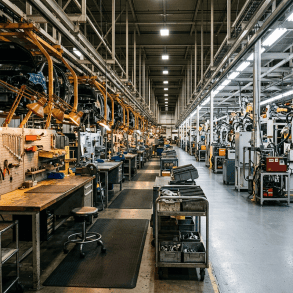
1,700 new American jobs and billions of dollars of investment is how Ford describes BlueOval Battery Park Michigan in that statement, producing batteries in Michigan with American workers for vehicles built in America. The company’s argument is that the licensing structure is what made domestic cell production possible at all, and that the alternative to licensing is importing the cells. That claim is checkable against the plant, and it is the strongest card Ford holds, because a plant with 1,700 people in it is harder to characterize as a foreign entanglement than a supply contract would be.
That distinction is the entire question, and it is not a Ford question. If licensing battery chemistry from a Chinese manufacturer constitutes a China tie for national-security purposes, then the category reaches most of the Western battery industry, because the licensing model is how non-Chinese manufacturers have accessed lithium iron phosphate cell design at competitive cost. If it does not, the department’s first concern falls away and the Geely, BYD and Lincoln items have to stand on their own.
The Trade Group Is Asking for the Same Line
September 3 also produced a letter to congressional leadership from the Alliance for Automotive Innovation, urging a permanent ban on the sale, import and manufacture of Chinese connected vehicles, hardware and software before the 119th Congress concludes. Alliance president and chief executive John Bozzella wrote that Chinese automakers are dumping subsidized vehicles with connected software and hardware around the world, capturing share in Europe, Australia, Southeast Asia, Mexico and South America. The vehicle is the Connected Vehicle Security Act of 2026, S. 4429.
GM, Ford, Stellantis, Toyota, Volkswagen and Honda are Alliance members. Ford is therefore a dues-paying member of a group asking Congress to write a China-content restriction into statute in the same week it is defending its own China-sourced battery license. Read as hypocrisy that is a cheap story. Read as a boundary dispute it is the actual one. The industry wants a line drawn around vehicle software and data systems, where Chinese suppliers are substitutable, and not around component licensing, where they are not.
The Connected Vehicle Rule is the instrument already in force, and it restricts Chinese-controlled vehicle software and data systems regardless of where a car is assembled. GCBC covered the Valencia arrangement in July against exactly that rule, and the Senate committee vote on S. 4429 that same month. S. 4429 has not passed. A bill in the session is not policy in force, and the distinction matters here more than usual, because the letter to Ford asks the company to act as though a statute already reaches its supplier agreements.
Where the Administration Sits
September 9 produced two more positions inside twenty-four hours. The House Select Committee on China posted that Ford warns of the threat Chinese companies pose while partnering with some of them, under the line that this is what Ford says against what it does, according to Reuters. The same day the White House posted that Ford is a great American company that has invested in US production, a materially softer position than the department’s letter. Ford’s own statement points further back, noting that a White House release the previous week had touted the Marshall project by name, and the Commerce Department praised the Lincoln reshoring decision in August that the transportation letter now calls too slow.
Three positions on one company’s supply chain, held simultaneously by one administration, is not a detail about that company. It is a signal to every automaker with a licensing agreement, a contract manufacturer or a phased reshoring plan that the standard they will be held to is not yet fixed. Capital does not move against an unsettled rule, which is the same reason GCBC has tracked the Honda plant decision against an open renegotiation rather than a known duty rate.
September 11 added a fourth. Asked about a Michigan senator’s claim that Chinese vehicle access could feature in a wider trade arrangement ahead of a September 24 White House meeting with China’s leadership, the White House called the claim phony, said the existing barriers stand, and said it would accept a Chinese automaker opening a plant in the United States to build cars with American workers. That position was first stated in Detroit in January. It is compatible with the department’s letter only if a Chinese-owned assembly plant is acceptable and a Chinese-licensed battery chemistry inside an American-owned one is not, and no document from the administration has yet drawn that line.
2030 is the date in dispute on the Lincoln item, and it is the one place where Ford is arguing about speed rather than category. Ford announced the increase in US Lincoln production on August 12, and says the Commerce Department praised that same decision at the time. Moving vehicle production out of China takes tooling, supplier qualification and a launch slot, and those are measured in years whatever the policy pressure. Ford’s global volume and the Lincoln series are where an accelerated timeline would show up as a gap before it shows up as a plant.
The useful question for the rest of the industry is not whether Ford wins this exchange. It is which of the five items the department chose to lead with, because that is the one it thinks it can enforce. It led with the battery license, which is the item with the widest reach and the least settled definition. Every automaker that has licensed cell technology rather than developed it should read that letter as addressed to them.