

Ford Mustang
Here you will find monthly and yearly United States and Canadian sales figures for the Ford Mustang. The Mustang is Ford’s iconic pony car, on sale since 1964, and it is now the last of the traditional American pony cars following the departure of the Chevrolet Camaro and Dodge Challenger. These figures cover the gasoline Mustang coupe and convertible; the electric Mustang Mach-E is tracked separately.
- Class: Two-door rear-wheel-drive pony car, offered as a fastback and a convertible, in its seventh generation
- Engines: 2.3-liter EcoBoost four-cylinder at 315 horsepower and 350 lb-ft; 5.0-liter Ti-VCT V8 at 480 horsepower and 415 lb-ft, or 486 horsepower and 418 lb-ft with the active exhaust; a modified 5.0-liter Coyote V8 at 500 horsepower in the Dark Horse
- Transmissions: Ten-speed automatic across the range, a six-speed manual with rev matching on GT and Dark Horse, and a TREMEC seven-speed dual-clutch on the Dark Horse SC
- Drivetrain: Rear-wheel drive
- Trims: EcoBoost and EcoBoost Premium, GT and GT Premium, and Dark Horse, Dark Horse Premium and Dark Horse SC
- Chief rivals: Nissan Z, Toyota GR Supra, Dodge Charger
The supercharged 5.2-liter V8 in the Dark Horse SC tops the lineup at up to 795 horsepower and 660 lb-ft, making it the most powerful factory Mustang Ford has built.
Ford Mustang Sales in the United States
The Mustang has held a remarkably steady place in the U.S. market in recent years, moving between roughly 45,000 and 53,000 units a year. Ford sold 53,159 in 2023 as the seventh-generation S650 arrived, then 47,212 in 2024 and 45,333 in 2025. The nameplate has picked up in 2026: through June, Ford sold 28,725 Mustangs in the United States, up about 22 percent from the 23,551 sold over the same period of 2025.
Ford Mustang, United States calendar-year unit sales, 2005–2026. 2026 is January–Aug (partial).
Annual sales
| Year | Units | YoY |
|---|---|---|
| 2005 | 160,975 | — |
| 2006 | 166,530 | ▲ 3.5% |
| 2007 | 134,626 | ▼ 19.2% |
| 2008 | 91,251 | ▼ 32.2% |
| 2009 | 66,623 | ▼ 27.0% |
| 2010 | 73,716 | ▲ 10.6% |
| 2011 | 70,438 | ▼ 4.4% |
| 2012 | 90,706 | ▲ 28.8% |
| 2013 | 77,186 | ▼ 14.9% |
| 2014 | 82,635 | ▲ 7.1% |
| 2015 | 122,349 | ▲ 48.1% |
| 2016 | 105,932 | ▼ 13.4% |
| 2017 | 81,866 | ▼ 22.7% |
| 2018 | 75,842 | ▼ 7.4% |
| 2019 | 72,489 | ▼ 4.4% |
| 2020 | 61,090 | ▼ 15.7% |
| 2021 | 52,384 | ▼ 14.3% |
| 2022 | 47,566 | ▼ 9.2% |
| 2023 | 53,159 | ▲ 11.8% |
| 2024 | 47,212 | ▼ 11.2% |
| 2025 | 45,333 | ▼ 4.0% |
| 2026 (Jan–Aug) | 35,778 | ▲ 15.4% YTD |
Monthly sales
| Year | Jan | Feb | Mar | Apr | May | Jun | Jul | Aug | Sep | Oct | Nov | Dec | Total |
|---|---|---|---|---|---|---|---|---|---|---|---|---|---|
| 2005 | 10,285 | 14,050 | 17,926 | 19,559 | 19,721 | 14,470 | 10,577 | 10,921 | 10,976 | 11,234 | 11,030 | 10,226 | 160,975 |
| 2006 | 11,208 | 13,367 | 16,117 | 15,868 | 15,559 | 15,165 | 13,711 | 17,933 | 14,341 | 11,786 | 10,230 | 11,245 | 166,530 |
| 2007 | 9,064 | 10,772 | 14,737 | 12,509 | 17,478 | 12,781 | 10,684 | 11,512 | 10,266 | 9,156 | 7,352 | 8,315 | 134,626 |
| 2008 | 6,545 | 7,752 | 10,180 | 10,050 | 9,633 | 10,893 | 10,711 | 8,197 | 4,910 | 4,686 | 3,667 | 4,027 | 91,251 |
| 2009 | 2,944 | 2,990 | 3,711 | 7,699 | 8,812 | 7,632 | 6,686 | 6,289 | 4,917 | 4,789 | 3,627 | 6,527 | 66,623 |
| 2010 | 4,747 | 5,115 | 5,829 | 5,145 | 10,225 | 8,974 | 7,489 | 5,570 | 5,760 | 5,317 | 4,093 | 5,452 | 73,716 |
| 2011 | 3,165 | 3,697 | 8,557 | 8,180 | 6,607 | 8,835 | 6,805 | 5,718 | 5,054 | 4,898 | 3,865 | 5,057 | 70,438 |
| 2012 | 3,736 | 14,702 | 9,046 | 7,801 | 10,427 | 10,623 | 7,371 | 6,387 | 4,439 | 5,328 | 5,309 | 5,537 | 90,706 |
| 2013 | 3,608 | 6,024 | 7,688 | 7,751 | 8,797 | 9,243 | 5,768 | 5,866 | 4,420 | 6,918 | 5,376 | 5,727 | 77,186 |
| 2014 | 3,881 | 6,410 | 9,305 | 7,243 | 9,761 | 7,631 | 6,564 | 5,878 | 3,158 | 4,565 | 8,728 | 9,511 | 82,635 |
| 2015 | 8,694 | 8,454 | 12,663 | 13,144 | 13,616 | 11,719 | 8,482 | 9,997 | 9,456 | 10,096 | 7,286 | 8,742 | 122,349 |
| 2016 | 7,580 | 9,993 | 12,563 | 12,726 | 10,327 | 9,776 | 9,565 | 8,299 | 6,429 | 5,414 | 6,196 | 7,064 | 105,932 |
| 2017 | 5,046 | 8,298 | 9,120 | 8,063 | 7,895 | 6,186 | 6,206 | 5,535 | 5,847 | 5,236 | 6,720 | 7,714 | 81,866 |
| 2018 | 4,732 | 5,800 | 8,632 | 7,125 | 8,739 | 7,400 | 5,934 | 7,487 | 5,770 | 4,924 | 4,907 | 4,392 | 75,842 |
| 2019 | 5,565 | 5,342 | 6,010 | 7,028 | 8,109 | 6,488 | 5,534 | 6,198 | 5,091 | 5,639 | 5,847 | 5,638 | 72,489 |
| 2020 | 5,869 | 7,598 | 4,602 | 2,829 | 6,287 | 6,601 | 4,857 | 4,317 | 4,677 | 4,399 | 4,119 | 4,935 | 61,090 |
| 2021 | 4,324 | 5,653 | 7,267 | 8,000 | 4,436 | 2,240 | 4,124 | 2,263 | 2,728 | 3,076 | 3,709 | 4,564 | 52,384 |
| 2022 | 5,671 | 4,700 | 3,615 | 4,377 | 3,234 | 4,647 | 3,367 | 3,533 | 3,454 | 3,848 | 3,259 | 3,861 | 47,566 |
| 2023 | 4,004 | 4,959 | 10,302 | 5,141 | 3,559 | 2,060 | 1,233 | 2,036 | 6,575 | 4,270 | 4,293 | 4,727 | 53,159 |
| 2024 | 3,771 | 4,115 | 5,821 | 4,657 | 5,174 | 3,906 | 3,209 | 6,373 | 2,668 | 2,688 | 2,355 | 2,475 | 47,212 |
| 2025 | 2,399 | 2,792 | 4,186 | 4,922 | 5,010 | 4,242 | 4,229 | 3,235 | 1,803 | 3,845 | 4,207 | 4,463 | 45,333 |
| 2026 | 3,609 | 4,313 | 6,152 | 5,830 | 4,920 | 3,901 | 3,406 | 3,647 | — | — | — | — | 35,778 |
Ford Mustang Sales in Canada
In Canada the Mustang has been steady as well, holding between about 3,500 and 3,800 units a year. Ford Canada sold 3,695 in 2025, and the first half of 2026 has essentially matched the prior year, with 1,853 sold through June against 1,843 a year earlier.
Ford Mustang, Canada calendar-year unit sales, 2004–2026. 2026 is January–Jun (partial).
Annual sales
| Year | Units | YoY |
|---|---|---|
| 2004 | 6,968 | — |
| 2005 | 10,045 | ▲ 44.2% |
| 2006 | 9,150 | ▼ 8.9% |
| 2007 | 7,987 | ▼ 12.7% |
| 2008 | 6,261 | ▼ 21.6% |
| 2009 | 5,200 | ▼ 16.9% |
| 2010 | 5,232 | ▲ 0.6% |
| 2011 | 4,433 | ▼ 15.3% |
| 2012 | 5,181 | ▲ 16.9% |
| 2013 | 5,054 | ▼ 2.5% |
| 2014 | 5,605 | ▲ 10.9% |
| 2015 | 6,933 | ▲ 23.7% |
| 2016 | 7,655 | ▲ 10.4% |
| 2017 | 8,348 | ▲ 9.1% |
| 2018 | 8,055 | ▼ 3.5% |
| 2019 | 6,745 | ▼ 16.3% |
| 2020 | 4,636 | ▼ 31.3% |
| 2021 | 4,224 | ▼ 8.9% |
| 2022 | 3,808 | ▼ 9.8% |
| 2023 | 3,491 | ▼ 8.3% |
| 2024 | 3,818 | ▲ 9.4% |
| 2025 | 3,695 | ▼ 3.2% |
| 2026 (Jan–Jun) | 1,853 | ▲ 0.5% YTD |
Monthly sales
| Year | Jan | Feb | Mar | Apr | May | Jun | Jul | Aug | Sep | Oct | Nov | Dec | Total |
|---|---|---|---|---|---|---|---|---|---|---|---|---|---|
| 2004 | 111 | 177 | 428 | 976 | 1,583 | 872 | 493 | 559 | 309 | 229 | 693 | 538 | 6,968 |
| 2005 | 343 | 632 | 1,192 | 1,932 | 1,719 | 1,432 | 685 | 471 | 504 | 374 | 345 | 416 | 10,045 |
| 2006 | 315 | 401 | 1,053 | 1,461 | 1,501 | 1,194 | 970 | 917 | 420 | 328 | 322 | 268 | 9,150 |
| 2007 | 245 | 251 | 600 | 992 | 1,749 | 1,153 | 1,080 | 703 | 383 | 375 | 258 | 198 | 7,987 |
| 2008 | 261 | 414 | 450 | 739 | 1,627 | 747 | 621 | 591 | 229 | 191 | 212 | 179 | 6,261 |
| 2009 | 184 | 206 | 441 | 641 | 867 | 616 | 898 | 488 | 325 | 206 | 160 | 168 | 5,200 |
| 2010 | 141 | 214 | 296 | 257 | 946 | 813 | 880 | 572 | 345 | 223 | 248 | 297 | 5,232 |
| 2011 | 160 | 79 | 206 | 444 | 789 | 1,140 | 591 | 377 | 245 | 129 | 110 | 163 | 4,433 |
| 2012 | 143 | 162 | 453 | 568 | 1,143 | 841 | 570 | 423 | 298 | 263 | 125 | 192 | 5,181 |
| 2013 | 123 | 107 | 505 | 578 | 1,246 | 650 | 555 | 479 | 328 | 228 | 150 | 105 | 5,054 |
| 2014 | 105 | 192 | 448 | 492 | 1,256 | 622 | 539 | 445 | 292 | 172 | 235 | 807 | 5,605 |
| 2015 | 146 | 190 | 732 | 825 | 1,401 | 972 | 708 | 520 | 422 | 250 | 415 | 352 | 6,933 |
| 2016 | 232 | 289 | 651 | 1,380 | 1,359 | 921 | 773 | 692 | 523 | 296 | 247 | 292 | 7,655 |
| 2017 | 233 | 403 | 669 | 1,028 | 1,698 | 1,268 | 978 | 862 | 511 | 246 | 234 | 218 | 8,348 |
| 2018 | 328 | 413 | 961 | 1,291 | 1,690 | 744 | 822 | 583 | 466 | 241 | 238 | 278 | 8,055 |
| 2019 | 350 | 319 | 336 | 1,275 | 1,275 | 1,161 | 528 | 528 | 482 | 176 | 153 | 162 | 6,745 |
| 2020 | 204 | 185 | 206 | 554 | 504 | 556 | 600 | 573 | 574 | 233 | 212 | 235 | 4,636 |
| 2021 | 233 | 233 | 268 | 661 | 601 | 663 | 367 | 385 | 369 | 145 | 145 | 154 | 4,224 |
| 2022 | 265 | 253 | 292 | 395 | 395 | 416 | 384 | 442 | 405 | 187 | 187 | 187 | 3,808 |
| 2023 | 300 | 273 | 316 | 312 | 344 | 345 | 231 | 265 | 232 | 304 | 291 | 278 | 3,491 |
| 2024 | 310 | 296 | 297 | 317 | 317 | 290 | 339 | 339 | 309 | 360 | 313 | 331 | 3,818 |
| 2025 | 314 | 286 | 301 | 323 | 309 | 310 | 308 | 294 | 295 | 343 | 283 | 329 | 3,695 |
| 2026 | 314 | 281 | 309 | 300 | 363 | 286 | — | — | — | — | — | — | 1,853 |
Ford Mustang Generation History
First Generation (1964½-1973)
The original Mustang revolutionized the American automotive industry when it debuted on April 17, 1964, at the New York World’s Fair. Early production units built from March through August 1964 are known as “1964½” models, though Ford titled all units as 1965 models. Production started five months early because Ford knew it had a hit.
Built on Ford Falcon and Fairlane components to maintain an affordable $2,368 base price, the first Mustang offered extensive customization. Buyers could configure anything from an economical daily driver to a high-performance muscle car.
Body Styles:
- Two-door hardtop coupe (launch)
- Convertible (launch)
- Fastback 2+2 (added August 1964)
Key Engine Milestones:
1964½-1965:
- 170 cubic-inch inline-six: 101 hp
- 289 cubic-inch V8: up to 271 hp
- Late 1965: 200 cubic-inch six with 120 hp
1967 Major Redesign:
The car grew to accommodate big-block engines. New options included:
- 390 cubic-inch V8: 335 hp (top performer)
- 302 cubic-inch V8: replaced high-output 289s
- 428 Cobra Jet V8: 335 hp, 440 lb-ft (drag racing special)
1969 Performance Peak:
- 351 Windsor V8: 250-290 hp
- Boss 302: 290 hp (Trans-Am racing homologation)
- Boss 429: 375 hp (NASCAR homologation with massive engine)
- Mach 1 performance package introduced
1971-1973 Decline:
The Mustang grew to its largest size with controversial styling. Emissions regulations killed performance. The 429 big-block disappeared for 1972. Sales declined as the muscle car era ended.
Legendary Special Models:
- Shelby GT350 (1965-1970): Race-bred performance with distinctive styling
- Shelby GT500 (1967-1970): Big-block muscle car icon
- Boss 302 (1969-1970): Trans-Am racing special, highly collectible
- Boss 429 (1969-1970): NASCAR homologation with massive engine
- Mach 1 (1969-1973): Sporty performance at accessible pricing
Second Generation (1974-1978) – Mustang II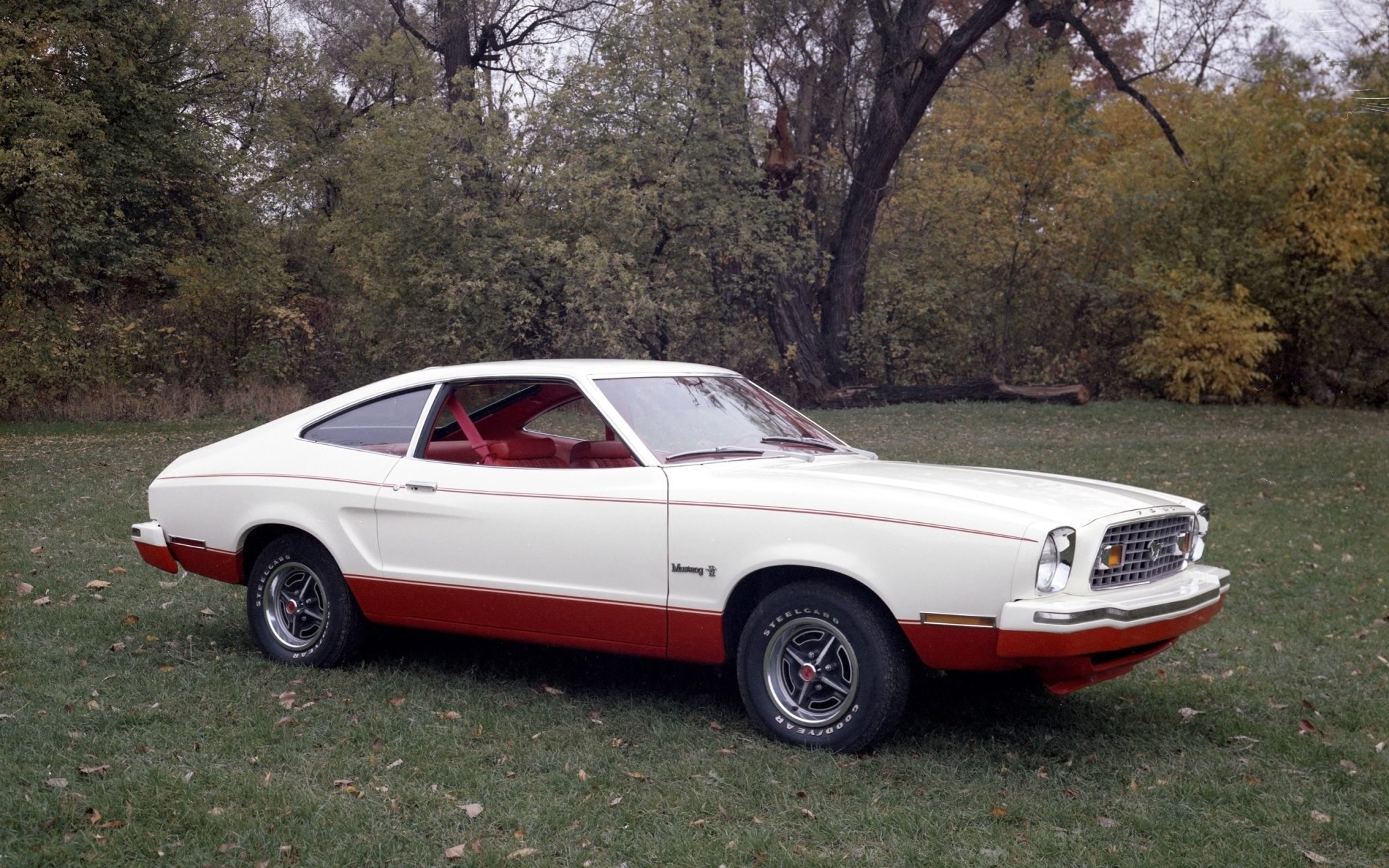
The Mustang II arrived during one of the most challenging periods in automotive history. The 1973 oil crisis, new emissions regulations, and fuel economy standards forced Ford to completely reimagine the Mustang as a smaller, lighter, efficiency-focused car.
The Transformation:
Based on the Ford Pinto platform, the Mustang II was:
- 19 inches shorter than the 1973 Mustang
- Over 500 pounds lighter
- Focused on fuel efficiency over performance
Despite criticism from performance enthusiasts, it outsold the Chevrolet Camaro in 1974 and won Motor Trend’s Car of the Year award.
Body Styles:
- Two-door notchback coupe
- 2+2 hatchback
- No convertible offered (first time since 1964)
Engine Options:
- 2.3-liter inline-four: 88 hp (standard)
- 2.8-liter V6: 105 hp (optional)
- 4.9-liter V8: 140 hp (reintroduced 1975)
Special Models:
- Cobra II (1976-1978): Aggressive graphics and Shelby-inspired styling
- King Cobra (1978): Bold hood graphics with mandatory V8
- Mach 1: Continued with sporty appearance upgrades
Legacy: While often criticized, the Mustang II kept the nameplate alive when many muscle cars disappeared entirely. Without its commercial success, Ford might have discontinued the Mustang altogether.
Third Generation (1979-1993) – Fox Body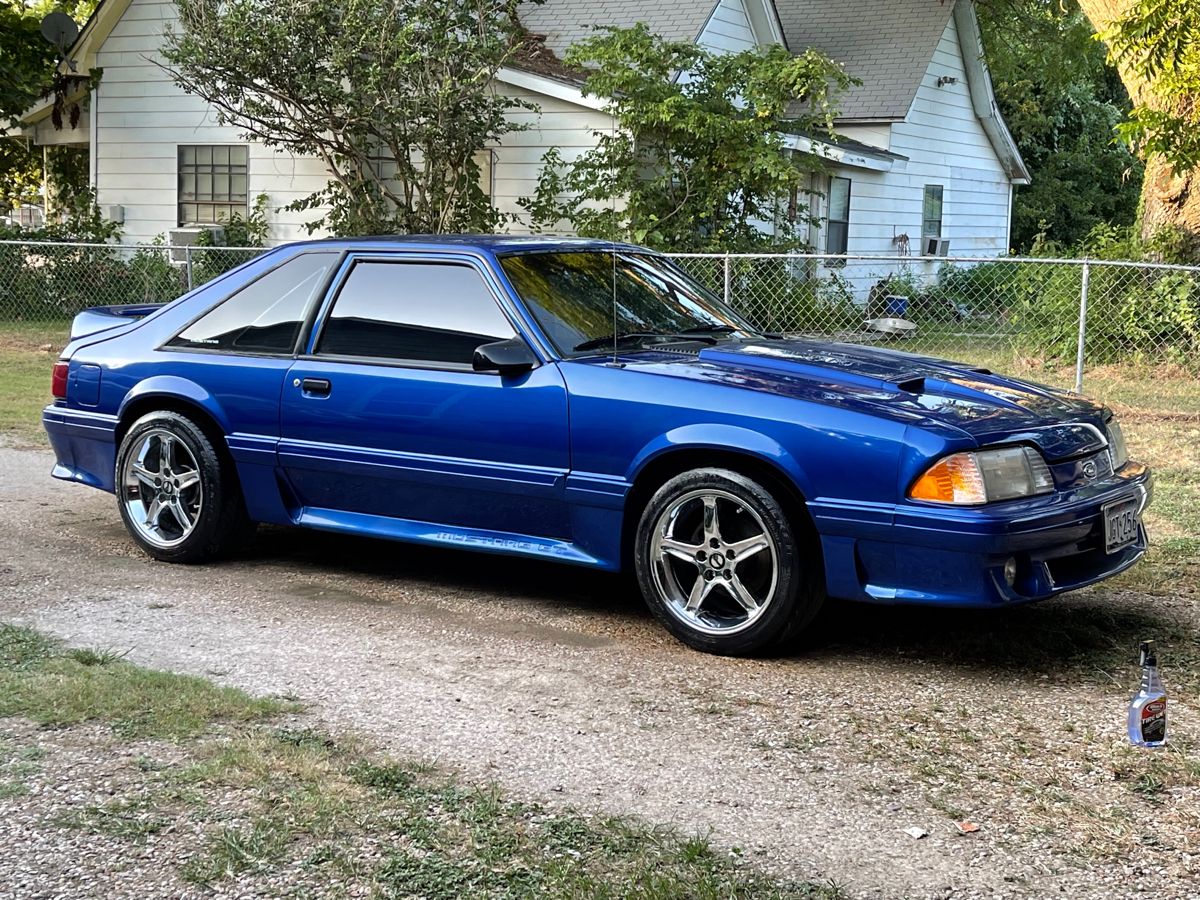
The Fox Body Mustang represented a return to performance and spawned one of the most beloved Mustang generations. Built for 15 years—the longest run of any Mustang generation—it emphasized lighter weight and better handling while gradually restoring V8 performance.
The 1979 Mustang shed 200 pounds compared to the Mustang II while offering improved interior space. The Fox Body 5.0 became the ultimate 1980s/1990s street performance icon.
Body Styles:
- Three-door hatchback
- Two-door notchback coupe
- Convertible (returned 1983 after nine-year absence)
Engine Evolution:
The Legendary “5.0” V8:
- 1979-1981: 140 hp (emissions-restricted era)
- 1982-1985: 157-210 hp (progressive improvements)
- 1986-1992: 225 hp (sequential fuel injection breakthrough)
- 1993: 205 hp (final year)
Other Options:
- 2.3-liter inline-four: 88-90 hp base engine
- 2.3-liter turbocharged four: 132-145 hp (SVO only)
- 3.8-liter V6: 105 hp (1983-1986)
Notable Models:
- Mustang SVO (1984-1986): Turbocharged four-cylinder with upgraded suspension, Koni dampers, four-wheel disc brakes. Approximately 9,800 produced.
- 1987 Redesign: Aerodynamic improvements with flush headlights, body-colored bumpers, refined interior. Many consider 1987-1993 the Fox Body pinnacle.
- 1993 SVT Cobra: 235 hp final-year sendoff, only 5,000 produced
Cultural Impact: The Fox Body 5.0 dominated street racing with its lightweight construction (around 3,000 pounds), V8 power, rear-wheel drive, and affordable pricing. It spawned a massive aftermarket industry that thrives today.
Fourth Generation (1994-2004) – SN-95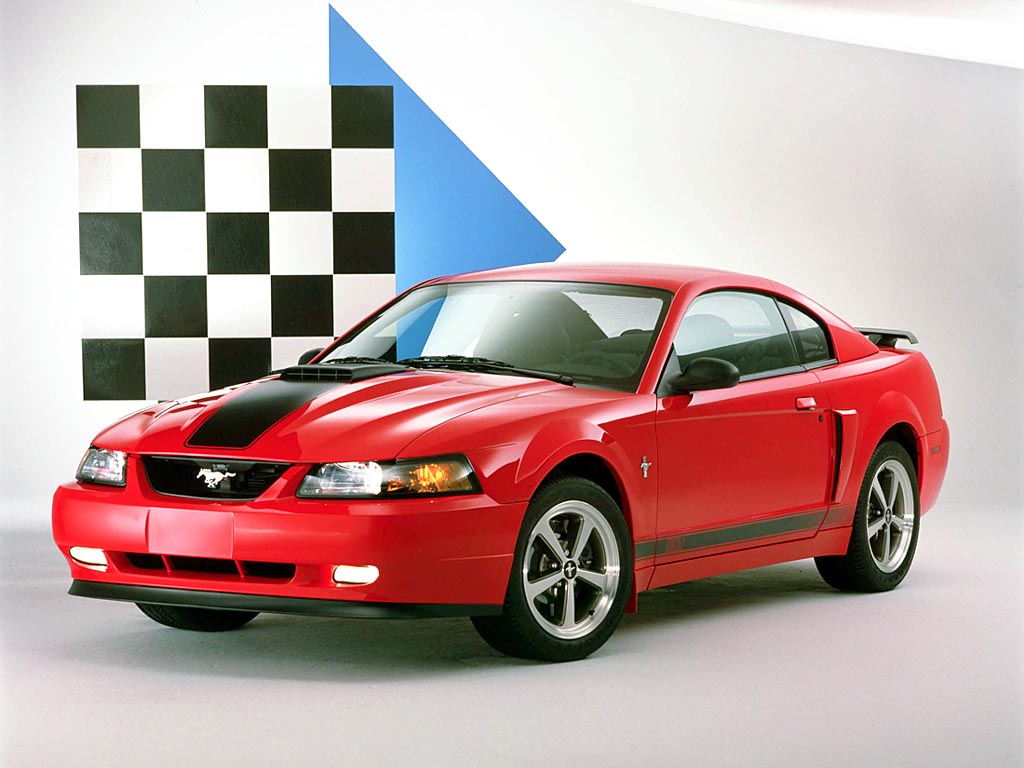
The fourth-generation Mustang brought contemporary styling while retaining much of the Fox platform’s mechanical layout underneath. Ford successfully modernized the appearance with flowing, aerodynamic bodywork that attracted new buyers.
The design featured softer, more rounded styling that initially raised eyebrows but aged well. For the first time since 1964, no hatchback was available—replaced by a traditional trunk.
Body Styles:
- Two-door coupe (notchback only)
- Convertible
Engine Options:
- 3.8-liter V6: 145-190 hp (base engine)
- 4.6-liter SOHC Modular V8: 215-260 hp in GT (introduced 1996)
- 4.6-liter DOHC V8: 305-390 hp in SVT Cobra
Major Update – 1999 “New Edge”:
The styling refresh brought sharper, more aggressive body lines and increased performance:
- V6 jumped to 190 hp
- GT V8 reached 260 hp
- Larger wheel arches
- Edgier overall appearance
Special Models:
- SVT Cobra (1996-2004): DOHC V8 with 305-390 hp. The 1999-2001 Cobra featured independent rear suspension—a Mustang first.
- Cobra R (2000): Ultra-rare track special with 385 hp from 5.4-liter DOHC V8. Only 300 produced, no A/C or radio.
- Bullitt (2001): Highland Green tribute with 265 hp, unique wheels, subtle styling.
- Mach 1 (2003-2004): Bridged GT and Cobra with 305 hp, retro hood scoop.
- “Terminator” Cobra (2003-2004): Supercharged 390 hp, 390 lb-ft. Highly sought-after, capable of 12-second quarter miles stock.
Fifth Generation (2005-2014) – S197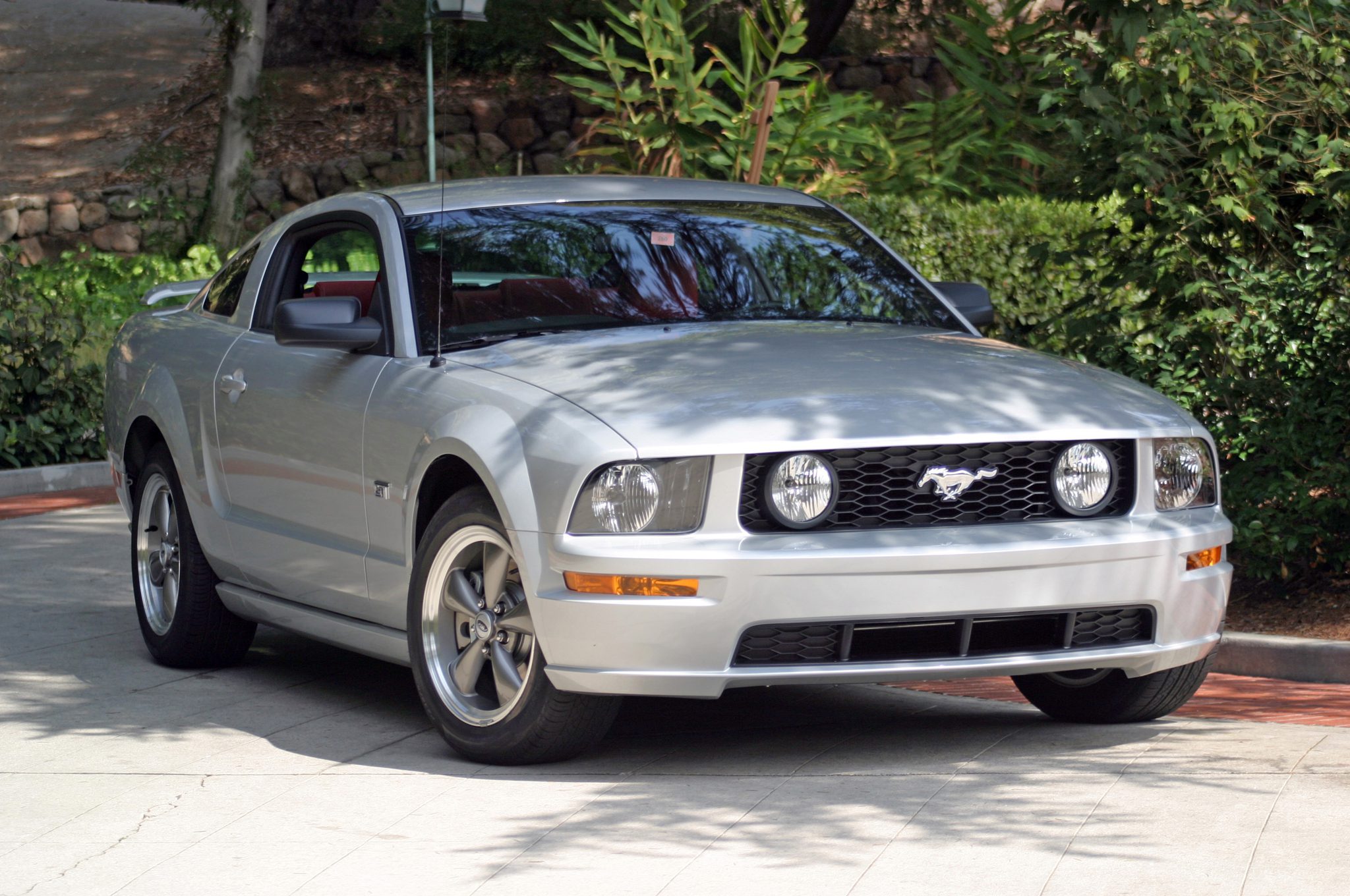
The fifth-generation Mustang marked the 40th anniversary with retro-modern styling paying homage to classic 1960s Mustangs. This generation proved immensely successful, selling over 500,000 units and winning widespread acclaim.
Ford’s design team created a modern interpretation of the 1967-1968 fastback with pronounced fender bulges, power-dome hood, and distinctive tri-bar taillights. The nostalgic styling resonated with buyers of all ages.
Body Styles:
- Two-door coupe
- Convertible
- Available across all trim levels from base V6 to supercharged GT500
Engine Evolution:
2005-2010:
- 4.0-liter V6: 210 hp (base)
- 4.6-liter V8: 300 hp (GT)
- 5.4-liter supercharged V8: 500-540 hp (GT500)
2011-2014 Revolution:
- 3.7-liter V6: 305 hp (more than previous GT models!)
- 5.0-liter “Coyote” V8: 412-420 hp (return of the legendary 5.0 badge)
- 5.8-liter supercharged V8: 662 hp (2013-2014 GT500)
Major Updates:
- 2010 Refresh: LED sequential taillights (Mustang first), improved interior quality, refined styling
- 2011 Powertrain Revolution: All-new engines, advanced stability management, launch control
Special Models:
- Shelby GT500 (2007-2014): Supercharged flagship escalating from 500 hp to 662 hp. Competed with Corvette and European sports cars.
- Boss 302 (2012-2013): Track weapon with 444 hp naturally aspirated V8. Laguna Seca variant added extreme track features with TracKey system.
- Bullitt (2008-2009): Dark Highland Green tribute with 315 hp, retro wheels, subtle styling.
Sixth Generation (2015-2023) – S550
The sixth-generation Mustang was Ford’s most ambitious: a truly global sports car engineered for worldwide sales with factory right-hand drive. This generation introduced independent rear suspension as standard—a historic first—and became available in over 140 countries as the world’s best-selling sports coupe.
Independent rear suspension finally gave Mustang the sophisticated chassis dynamics to compete with European sports cars. Every aspect of the driving experience was refined.
Body Styles:
- Two-door fastback coupe
- Convertible
Engine Evolution:
2015-2017:
- 3.7-liter V6: 300 hp (base, discontinued 2018)
- 2.3-liter EcoBoost: 310-330 hp (turbocharged four-cylinder)
- 5.0-liter Coyote V8: 435 hp (GT)
2018-2023 Updates:
- 2.3-liter EcoBoost: 330 hp
- 5.0-liter Coyote V8: 460-480 hp (third-generation)
- 5.2-liter “Voodoo” V8: 526 hp (GT350, flat-plane crank)
- 5.2-liter “Predator” V8: 760 hp (GT500, supercharged)
Major Updates:
- 2018 Facelift: Revised styling, dropped V6, increased power, new 10-speed automatic, 12-inch digital instrument cluster
- Technology: SYNC 3 infotainment, selectable drive modes, MagneRide adaptive dampers (available)
Special Models:
- Shelby GT350/GT350R (2015-2020): Flat-plane crank V8 with 8,250 rpm redline. Many consider this the greatest naturally aspirated Mustang ever built for its sublime chassis dynamics.
- Shelby GT500 (2020-2022): 760 hp supercharged beast, most powerful production Mustang until GTD. Quarter miles under 11 seconds.
- Bullitt (2019-2020): Film’s 50th anniversary tribute with Dark Highland Green paint and 480 hp.
- Mach 1 (2021-2023): Performance model with GT350 components, Tremec manual, 480 hp. Fitting S550 swan song.
Achievement: The S550 proved Mustang could compete globally with European sports cars. GT350R earned comparisons with Porsche 911 GT3s.
Seventh Generation (2024-Present) – S650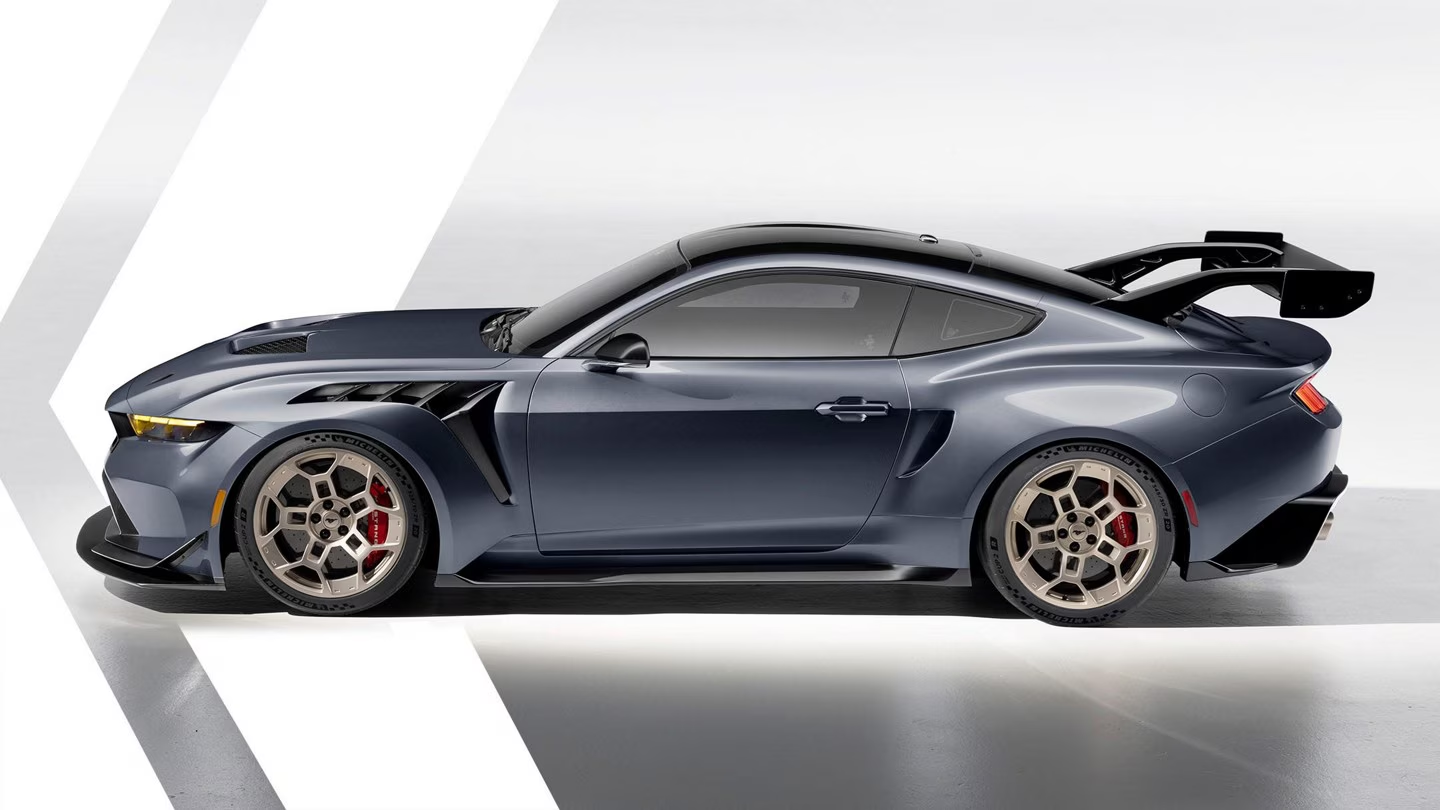
The seventh-generation Mustang debuted September 14, 2022. While evolutionary—retaining S550’s basic structure—Ford calls it legally “all-new” with extensive updates. The S650 arrives as the last American pony car standing after Camaro and Challenger discontinued production.
Designer Chris Walter emphasized “edgy and sexy” themes, creating sharp, aggressive bodywork with the lowest drag coefficient and most downforce of any production Mustang.
Body Styles:
- Two-door fastback coupe
- Convertible
Engine Options:
- 2.3-liter EcoBoost: 315 hp, 350 lb-ft (most powerful four-cylinder Mustang ever, all-new fourth-generation engine)
- 5.0-liter Coyote V8: 480-500 hp (fourth-generation with dual intake/dual throttle body system)
Technology Highlights:
- Dual 12-inch displays (digital cluster and touchscreen integrated)
- Configurable gauge themes including retro Fox Body graphics
- Unreal Engine-powered drive mode visualization
- Electronic Drift Brake (developed with Formula Drift champion)
- Ford SYNC 4 with over-the-air updates
- Remote Rev (key fob engine revving on manual models)
Trim Levels & Pricing:
- EcoBoost: Starting ~$32,000
- EcoBoost Premium: Upgraded interior and features
- GT: Starting ~$43,000 with 480 hp V8
- GT Premium: Enhanced comfort and technology
- Dark Horse: Starting ~$60,000 with 500 hp
- Dark Horse Premium: Upgraded appointments
Special Models:
Dark Horse – First New Performance Series in Two Decades:
- 500 hp from uniquely calibrated Coyote V8
- TREMEC TR-3160 manual with 3D-printed titanium shift knob
- Enhanced cooling with additional heat exchangers
- Track-focused suspension geometry
- Comprehensive aerodynamic package
Mustang GTD (2025) – Ultimate Mustang:
- Street-legal GT3 racer built by Multimatic
- Supercharged 5.2-liter “Predator” V8: 815 hp, 664 lb-ft
- Rear-mounted eight-speed dual-clutch transaxle
- Active aerodynamics with massive rear wing
- Extensive carbon fiber body panels
- Pushrod suspension with inboard dampers
- Starting price over $300,000
- Nürburgring lap: 6:57.685 (December 2024), improved to 6:52.072 (May 2025)
- First American production car to break seven minutes at the Ring
Performance Improvements:
- New steering rack: 15.5:1 ratio (vs. 16:1 in S550) with stiffer mounting
- Revised suspension geometry for better handling balance
- Available MagneRide adaptive dampers
- Optimized weight distribution
- Improved aerodynamics for efficiency and stability
Ford Mustang Mach-E: A Separate Model
The Ford Mustang Mach-E is a battery-electric compact crossover SUV introduced November 2019 as a 2021 model. It shares the Mustang name and design cues but is completely separate, built on the Global Electrified 1 (GE1) platform—entirely different from rear-wheel-drive architecture used in traditional Mustangs.
Key Specifications:
- Body Style: Five-door electric crossover
- Drive: Rear-wheel drive or all-wheel drive
- Battery: Standard-range (68 kWh) or extended-range (88 kWh)
- Range: 210-320 miles EPA-estimated
- Charging: DC fast charging up to 150 kW
- Power: 266-480 hp depending on trim
Available Trims:
- Select: Base trim with standard features
- Premium: Mid-level with enhanced comfort
- GT: Performance-oriented with 480 hp
- Rally: Off-road-capable variant (introduced 2024)
Important Distinction:
The Mach-E is NOT counted among Mustang’s seven generations. It is a separate model line produced alongside the traditional two-door Mustang, not a chronological successor. Ford positions it as an expansion of the Mustang brand into the electric SUV segment.
Assembled at Cuautitlán Assembly in Mexico, while traditional Mustangs are built in Flat Rock, Michigan. The Mach-E won 2021 North American SUV of the Year and has been well-received for performance and technology, though traditionalists remain divided on whether an electric crossover should carry the Mustang name.

not true about the 2006 sales, i work at Ford, but the sales in 2006 were 189,452.
Coolautosman is almost correct, im doing research on the ford mustang and in 2006, the mustang sells were 190,192
you are not correct
Ford says they sold 166,530 in 2006. Automotive News concurs.
http://media.ford.com/pdf/December06sales.pdf
Moreover, Ford reiterated the 2006 sales volume one year later. http://media.ford.com/pdf/December07sales.pdf
well I work at Ford, in the mustang section, and im looking at the sells chart, we brought were 189,452
you are both wrong, i have been researching the mustang since 2004, and the sales 190,192
Sounds perfectly reasonable if the numbers are global. It's hard to argue with two consecutive Ford press releases.
no, the sells of global were 199,854.
I have been reaserching the mustang, when you have 13 websites saying the same thing, my son showed me all of them.
Automaniac is correct except he missesd it by 2 sells it actually 190,190
Thanks for the info, Autoreseacher and automaniac, how long have you two been reseaching mustangs?
7 years, how about you Autoreseacher?
9 years and counting.
Aaaaand, Ford's corporate communications rep confirms the 166,530 figure, so we'll moderate the troll's comments.
this is incorrect…
yes Carman, it is incorrect.